How Miro, Babbel, Contentsquare, Ablefy, and GetYourGuide are changing the way they work
Notes from ProductLab Berlin: how GetYourGuide, Miro, Babbel, Contentsquare, Ablefy, and n8n are changing the way product teams work with AI.

It's been a LONG time since I went to a conference, probably since before the pandemic. Like everyone else, I got into the habit of learning online. But several people here in Berlin mentioned the ProductLab conference, and I spent €400 of my own money to go for one day (I swallowed hard before signing up).
I need to network right now, but like most people I hate "networking." What I really wanted was to get out of my own head and hear what others are actually doing to transform the way we work as PMs. It's easy to read online and feel scared or hopeless. I left the day feeling inspired and hopeful about what's possible for all of us when we have clarity, learning cultures, and small teams of flexible people.
Here are some of the highlights for me.
Polish no longer tells you how much thinking went into something
Jana Waldschmidt at GetYourGuide talked about how we used to be able to judge effort based on the quality of a finished output. High quality meant a lot of thought and effort had gone into something - whether it's a case study for a job application or a strategy deck at work. Now that's not the case; we can all create polished outputs without thinking about them.
She also talked about how everyone has different levels of fears about what's going on; how people's identities are at risk, and how we need to talk about this directly with our teams to make it through this transition, with a mindset of experimentation.
Thoughtful organizations have an advantage
Joe McLean and Vihar Parikh from Miro shared a lot of details about what practically has changed in their AI implementation, but I was more interested in their cultural takes about how they are dealing with a "stressful level of acceleration and constant transformation". Vihar shared a model of the stages of AI adoption - from holdouts to explorers to scalers to AI-first. (I'll talk more about this in another post). They also talked about the collaboration gap - that AI might make the people faster but the company itself isn't faster yet. In their view, AI can amplify existing misalignment - when creation scales and decision-making does not. The flip side is that if you invest more in alignment, you can get the multiplicative effect that everyone is looking for.
I was really interested to hear about the longer-term challenges because Miro has been on this journey longer than many. They talked about how the thinking done by agents can easily become invisible, how agents working together sometimes build their own domain language resulting in jargon you can't read. They also talked about the 'danger of organizational misinformation'. This means - if plans and decisions change, but the changes aren't written down, agents often propagate outdated ideas. (I think about giving agents access to some of the Confluence spaces I've worked with and am terrified of this.) So organizational legibility of information is a huge problem to work on. (Just as it always has been - only now it's more urgent).
They also dug into the augmentation decay - how some heavy, dense skills created earlier in the transformation are getting in the way and confusing agents and need to be adapted.
This talk reinforced something I've suspected: that a thoughtful organization like Miro that is intentional about how they work together and that cares about clarity and focus has a huge advantage in adapting quickly to AI. I think a lot of organizations operate in an intuitive firefighting mode, and others operate in a highly formalized mode that drives people to work around the system all the time. These places aren't going to be able to create enough clarity for agents to work effectively.
At the end, Joe mentioned that a lot of working with agents is about being ok if the workflow is 80% of where you need it to be. He suggested that we "plan for the curve" and allow time, so that with a few months of technology improvements and learning, you can hit 100%.
Sometimes AI means rethinking everything
Diana Pulnar at Babbel talked about their experience diving in fully to AI - taking a team of 40-50 people to create the new generation of their product, which is not only built with AI but also AI driven. They faced a profound competitive market challenge (tons of new AI competitors) which forced them to really think about where they could play and how they could win. They're using Linear with Claude Code (a pairing I'd like to play with) and a radically flat structure (no managers; PMs and designers and engineers pulling features from the backlog together; alignment through a 15-30 minute standup with EVERYBODY(?!) 3x per week).
I think what's interesting is that they seem to have a 'coalition of the willing' where everyone on this team is highly motivated and empowered to find new ways of working. Diana said this approach only works with flexible people. And there's a selection at play; Babbel still has an established business that makes all the money, so there are still people working on keeping that running. I think acknowledging different people are moving at different speeds and have different concerns, and designing your org for this, is important. (I still wonder what she does with 1:1s!)
Improvement ideas come up at any time and are raised in the standup, so when it comes to the agentic workflow the team owns this and drives it on their own - quickly prototyping changes individually and then agreeing to deploy them together.
Formalizing product context so agents can use it
Jane Austin and Mariusz Cieśla talked about how Contentsquare is transforming their design process. They also had the same challenge Jana talked about earlier - when everything is polished, stakeholders don't know what is real, and so they created a structured prototype playground where every prototype shares details of its provenance. Mariusz is a design engineer who is creating tooling for the design workflow, which has led them to largely move away from Figma. Instead, they have automation that uses very structured data. The design system is formalized; the product context is formalized, and then designers can iterate in text to generate designs that can then be tested with customers.
I was most interested in what they called a 'context layer' - this is a formalized, curated input that the agents use automatically for all of their work:
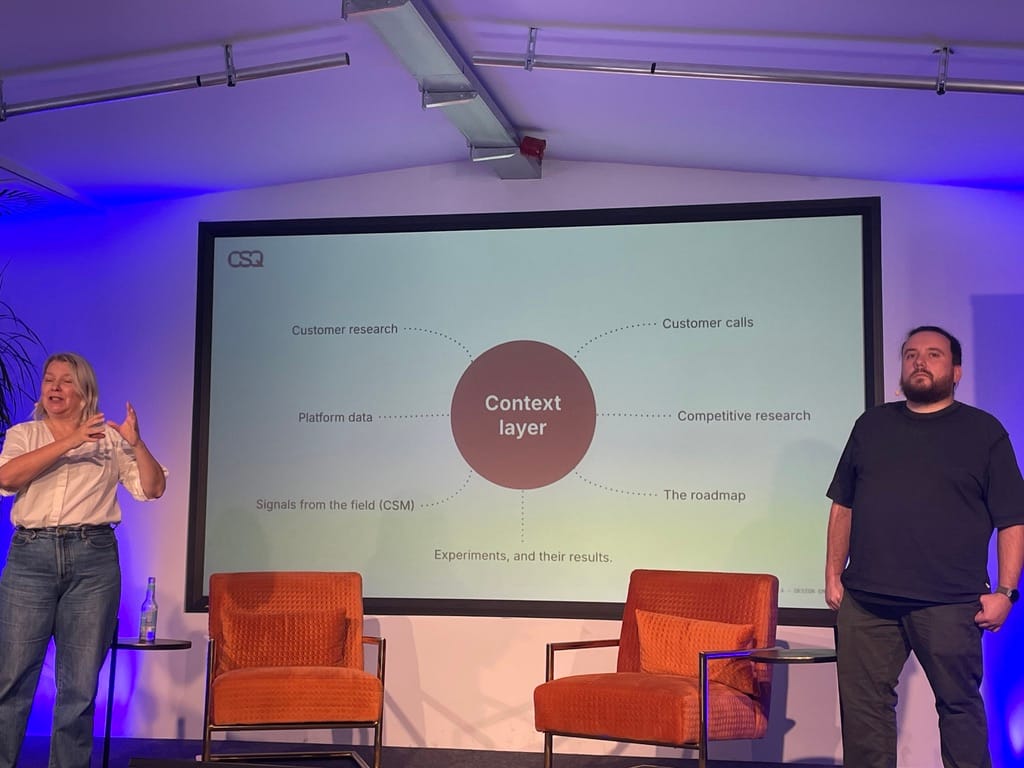
The context layer includes customer research, platform data, signals from the field, experiments and their results, customer calls, competitive research, and the roadmap. This is all stored in markdown in GitHub so the agents have easy access, and Mariusz has created further agents that keep this data in sync with wherever the 'source of truth' actually is. (At least one thing is in Confluence).
I think about how rare it is that a pre-AI company formalized all this stuff for designers. And even more rare that they keep it updated. It seems sensible that this would all be helpful for the designers. But for agents, it's essential. They can't infer context the way people can.
The prototyping work is done by autonomous trios of product, engineering, and design, and these trios rotate as the work changes. Again, you need flexible people, and Jane reinforced that "AI and culture need to go hand-in-hand."
Every mistake improves the agent harness
Guannan Li at Ablefy talked about how they created a speedboat team to run next to the 'battleship' of their existing business. They built out a new branded community product to offer to their existing customer base, and they did this with a team of 3, much smaller than their usual teams. (These teams of 3 seem to be a common pattern for agentic work 🤔) They have some role separation: a product builder focuses on the spec, prototype, and initial code, and the engineer focuses on backend and operationalization.
One of her observations really stuck with me - the flow between spec and prototype and code is much more flexible than you might think, because you can generate a spec from a prototype or from code. And in some cases, they found themselves working with detailed generated specs that nobody had time to read. The question of what to do with intermediate work products is one that's clearly up for debate - are PRDs and specs useful artifacts now, or are these things we can leave up to the agents and focus more on our intent and outcomes? (There used to be a thing called an MRD, a market requirements document, that you don't hear about much these days; maybe this will come back?) Their conclusion is regardless of whether any human reads the written spec, someone needs to be accountable for manually testing how the resulting product works.
Guannan also dug into the question everyone has - should we let PMs write code? And can they ship to production? They realized that this question depends on what kinds of quality gates you have. If you have a new codebase with high test coverage, and a review agent with teeth, it's much safer (in this domain). But you need to have shared ownership for quality (so the PM is not off the hook if problems arise). The other important piece is that every mistake the team makes must lead back to an improvement to the underlying agent harness. (This is the kind of 'stop the line' problem solving that enabled Toyota to become an automotive juggernaut, so I was happy to see it being applied to agentic work here in Berlin).
She also shared some stories about what happened when they started bringing learnings back from the speedboat team with the new codebase to the legacy cash cow business and its established platform. Changes got more difficult because test coverage is not the same. And they saw Claude hallucinate more because the older codebase was not as legible for it. Still, they've been able to start having designers ship small fixes (with responsibility). They've created a sandbox environment for rapid prototyping, which means the PMs and designers had to learn branching and merging from the developers. And they're leaning on the existing engineering team to build out the new agent harnesses for that environment.
Changing how we think about things
Finally, a chat between Jan Oberhauser, CEO of n8n, and Luca Rossi of Refactoring. Jan faced a profound challenge with his company as he realized AI would make their offerings obsolete, and he was frank with his team about the challenge - like Babbel, they had to both reinvent their way of working and also their product offering. He said that starting from a position of profitability was a huge advantage, because they didn't have to lose time on short-term revenue generation features in order to raise money. (It's a good reminder that financing sources change which moves are available to a company).
I liked that he talked about how AI changes not just how we work but also how we think about things. I think this is something that I'm only just aware of now - as we adopt AI we can tackle problems we didn't think were possible to solve before, and this generates completely new challenges around, "What comes next?" Jan said they've been able to be more ambitious about their future, about how many customers they might serve with 1000 employees.
Even I don't make time for serious play
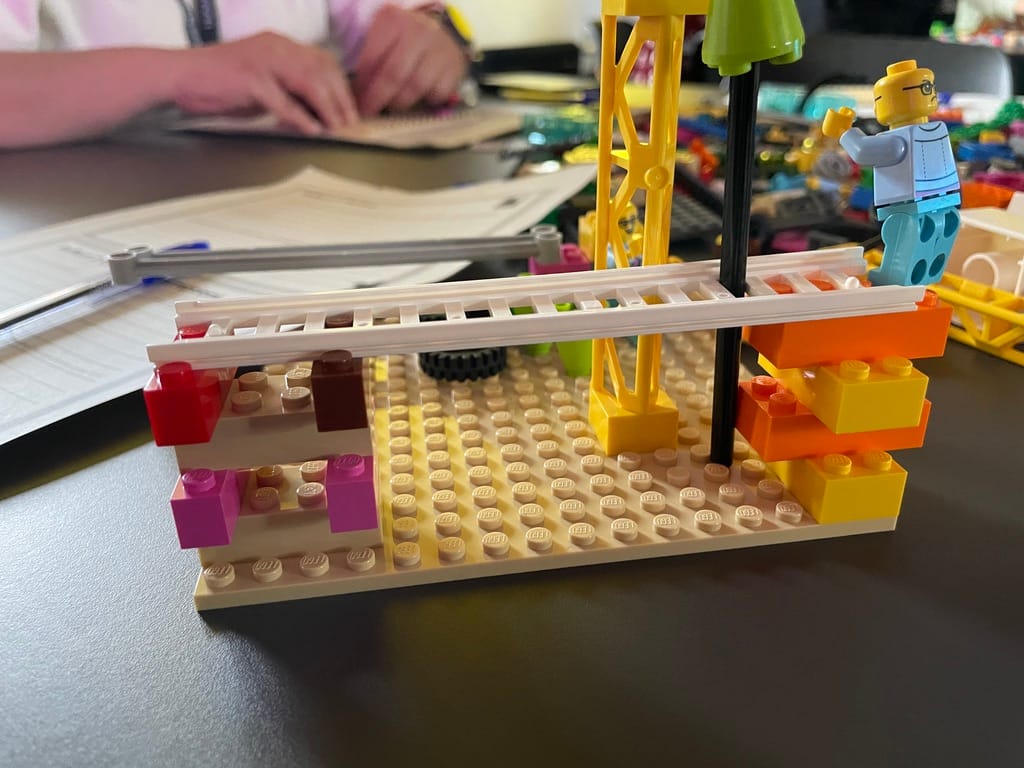
I guess I'm learning the clarinet as an adult, so that's something. But I've heard about LEGO Serious Play for like 15 years and never had a chance to do it. So I was happy that Alexandru Bleau offered a session on 'The conversation you're avoiding'. I had a chance to spend a half hour building and getting unstuck. Highly recommended
PMs should go to more conferences
It was an inspiring event for me. If you are getting most of your AI and product news from Substack and LinkedIn, the tone is off. In a way, I think a conference presentation can be much more raw and real than the way we write on LinkedIn. I was happy to see people face to face, to get to meet a few new people, and to get the sense of Berlin's product scene, which I've often been too busy to take part in. My understanding is that Daniele Ronca at ProductLab has been a key driver of building this since 2022, while I wasn't looking.
And as far as AI goes - everyone is on this journey; everyone I talked to is a little afraid, as Jana said; nobody knows where it is actually going; most of the PMs did not talk about AGI and the end of the world; companies are a little scared to invest in people right now. But I do not see the amount of work declining right now. We have new ways of working with smaller teams, just as we did with XP in the year 2000. I think there is room for us to still build more (if we get the financing right!)
How are you doing in terms of hope for this time of change? I'd love to hear from you in the comments (or privately).